From the blog
Micrograms vs. Milligrams on Supplement Labels: Why 100 mcg Is So Small
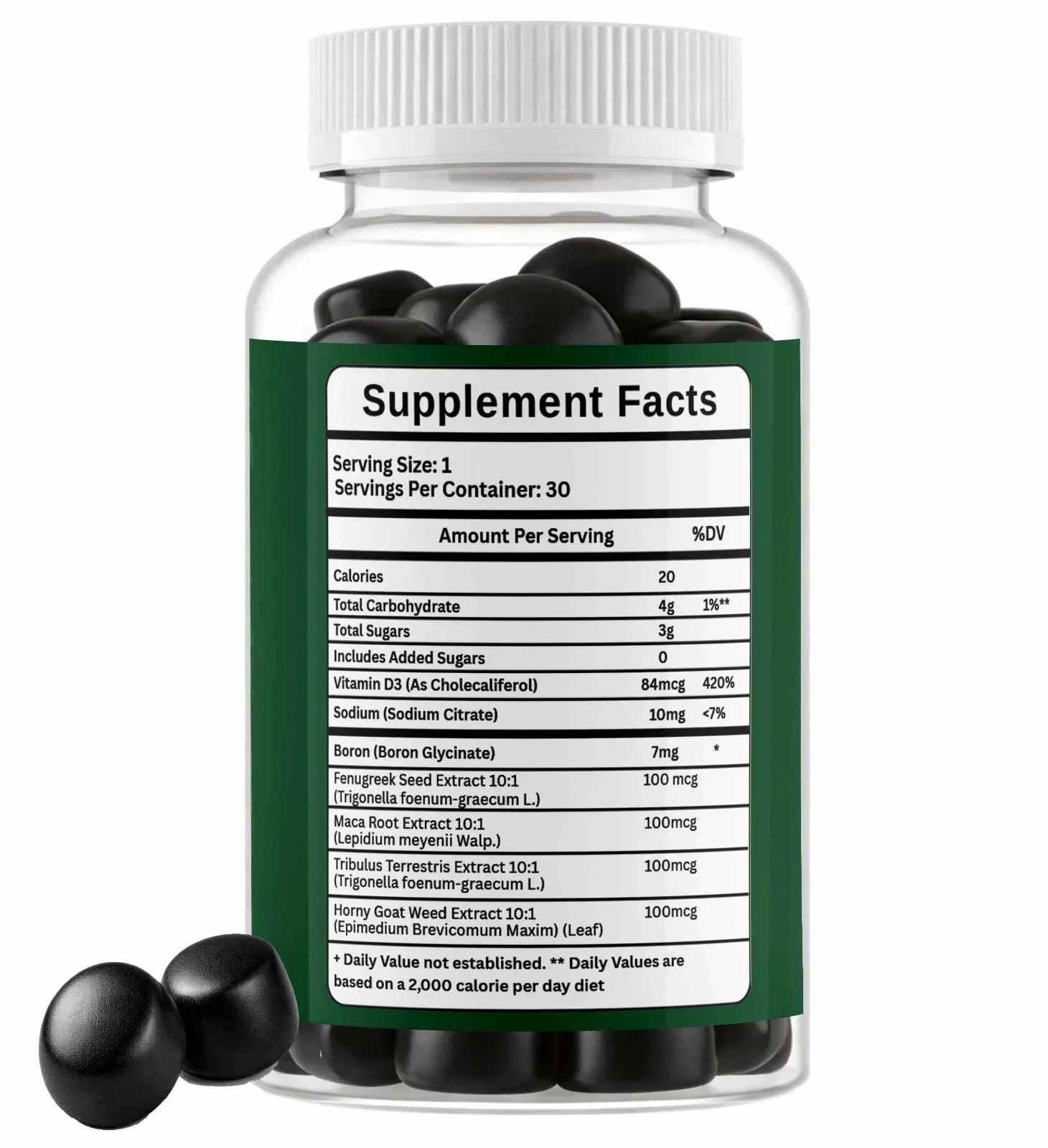
A microgram (mcg) is one thousandth of a milligram (mg). So 100 mcg equals 0.1 mg. On the Military Honey label, each of the four herb extracts is 100 mcg. Even as 10:1 extracts, that is roughly 1 mg of raw herb, far below the hundreds of milligrams to grams used in most herbal research.
Why the units on a label matter
Every page, every journal post, the bottle facts and the ingredients are checked by Dr. Joette James, PhD against the label and the cited sources. Most people read a Supplement Facts panel from top to bottom and look at the ingredient names. The names are the fun part. They are also the part that tells you the least. The number and the unit next to each name tell you how much you actually get, and that is what decides whether an ingredient can do anything at all.
Supplement labels use three weight units: grams (g), milligrams (mg) and micrograms (mcg, sometimes written µg). Each one is a thousand times smaller than the one before. That is easy to say and easy to forget, because “100” looks like a big number no matter which unit follows it.
On the Military Honey panel, you can see all of these units on one small label. Carbohydrate and sugars are in grams, sodium and boron in milligrams, and vitamin D3 and the four herb extracts in micrograms. Reading them correctly changes the whole picture of what the gummy contains.
The simple conversion
Here is the one rule to remember: 1 gram = 1,000 milligrams, and 1 milligram = 1,000 micrograms. So 1 gram is one million micrograms.
To turn micrograms into milligrams, divide by 1,000. To turn milligrams into micrograms, multiply by 1,000. That is all the math you need for any supplement label.
| Amount | In mg | In mcg | Everyday comparison |
|---|---|---|---|
| 1 g | 1,000 mg | 1,000,000 mcg | About a small paper clip |
| 100 mg | 100 mg | 100,000 mcg | A typical herbal capsule dose, or less |
| 7 mg | 7 mg | 7,000 mcg | Military Honey’s boron |
| 1 mg | 1 mg | 1,000 mcg | A few grains of salt |
| 0.1 mg | 0.1 mg | 100 mcg | Each Military Honey herb extract |
Reading the Military Honey panel with the right units
Let us walk down the label with the units in mind. Vitamin D3 is listed at 84 mcg. For a vitamin, that is a lot: the Daily Value is 20 mcg, which is why the label prints 420%. Vitamins are measured in micrograms because the body needs only tiny amounts.
Boron is listed at 7 mg, which is 7,000 mcg. That is a meaningful amount for a trace mineral. Food gives most adults about 1 to 1.5 mg a day, and the adult upper limit is 20 mg (NIH Office of Dietary Supplements, “Boron: Fact Sheet for Health Professionals”).
Then come the four herbs: fenugreek seed, maca root, tribulus and horny goat weed. Each is 100 mcg. It is easy to read “100” and think it matches the other numbers. But 100 mcg of a plant extract is 0.1 mg, a tenth of a milligram.
| Ingredient | As printed | In mg | Is that a lot? |
|---|---|---|---|
| Vitamin D3 | 84 mcg | 0.084 mg | Yes, for a vitamin (420% DV) |
| Boron | 7 mg | 7 mg | Yes, for a trace mineral |
| Fenugreek extract 10:1 | 100 mcg | 0.1 mg | No, for an herb |
| Maca extract 10:1 | 100 mcg | 0.1 mg | No, for an herb |
| Tribulus extract 10:1 | 100 mcg | 0.1 mg | No, for an herb |
| Horny goat weed extract 10:1 | 100 mcg | 0.1 mg | No, for an herb |
Why vitamins use micrograms and herbs use milligrams
Vitamins and some minerals are powerful in tiny amounts. Your body needs only 15 to 20 mcg of vitamin D a day, and only a few micrograms of vitamin B12. That is why their doses are small numbers in micrograms.
Herbs are different. A plant is made mostly of fiber, water and ordinary plant material. The active compounds are a small fraction of the whole. That is why herbal research almost always uses doses in the hundreds of milligrams or in grams. A tea bag of chamomile holds about 1 to 2 grams of dried flowers. A typical maca study uses 1.5 to 3 grams of root powder a day.
So the unit tells you something by itself. When you see a plant extract listed in micrograms, it is a sign that the amount is small, unless the extract is a very concentrated, standardized compound with its own research.
What a 10:1 extract means
Each herb on the Military Honey label is called a . This is a common way of describing concentration. It means about 10 parts of raw plant were used to make 1 part of extract.
So 100 mcg of a 10:1 extract is roughly the same as 1,000 mcg, or 1 mg, of the raw plant. Makers sometimes describe this as “equivalent to” the larger amount. Even at that equivalent, 1 mg of seed or root is a pinch too small to see.
Extract ratios are also not a standard of quality. A 10:1 ratio tells you how much plant went in, not how much of any active compound came out. Some extracts are “standardized” to a percentage of a known compound, such as icariin in horny goat weed. The Military Honey label does not state any standardization.
| Herb | On label | Raw-herb equivalent (10:1) | Common research amounts |
|---|---|---|---|
| Fenugreek seed | 0.1 mg | ~1 mg | Hundreds of mg of extract a day |
| Maca root | 0.1 mg | ~1 mg | 1.5–3 g of root a day |
| Tribulus | 0.1 mg | ~1 mg | Hundreds of mg a day |
| Horny goat weed | 0.1 mg | ~1 mg | Varies; human data limited |
How to compare a label with research
You do not need to read studies to use this idea. You only need to know roughly what amount research used and compare it with the label.
For fenugreek, NCCIH describes studies on blood sugar and other uses (National Center for Complementary and Integrative Health, “Fenugreek: Usefulness and Safety”); the amounts in those studies are in grams of seed or hundreds of milligrams of extract. For maca, Memorial Sloan Kettering summarizes small studies that used grams of root (Memorial Sloan Kettering Cancer Center, “Maca (About Herbs)”). For horny goat weed, MSK notes that human evidence is limited (Memorial Sloan Kettering Cancer Center, “Epimedium / Horny Goat Weed (About Herbs)”).
When the label amount is a thousand times smaller than the research amount, the research does not tell you what the product will do. It is not proof that the product does nothing. It simply means the studies do not apply to this dose.
Find the unit
g, mg or mcg.
Convert to mg
Divide mcg by 1,000.
Check for ratios
A 10:1 extract is about 10 times the raw herb.
Find a research range
A trusted summary such as NIH or MSK.
Compare
Is the label within the same range, or far below it?
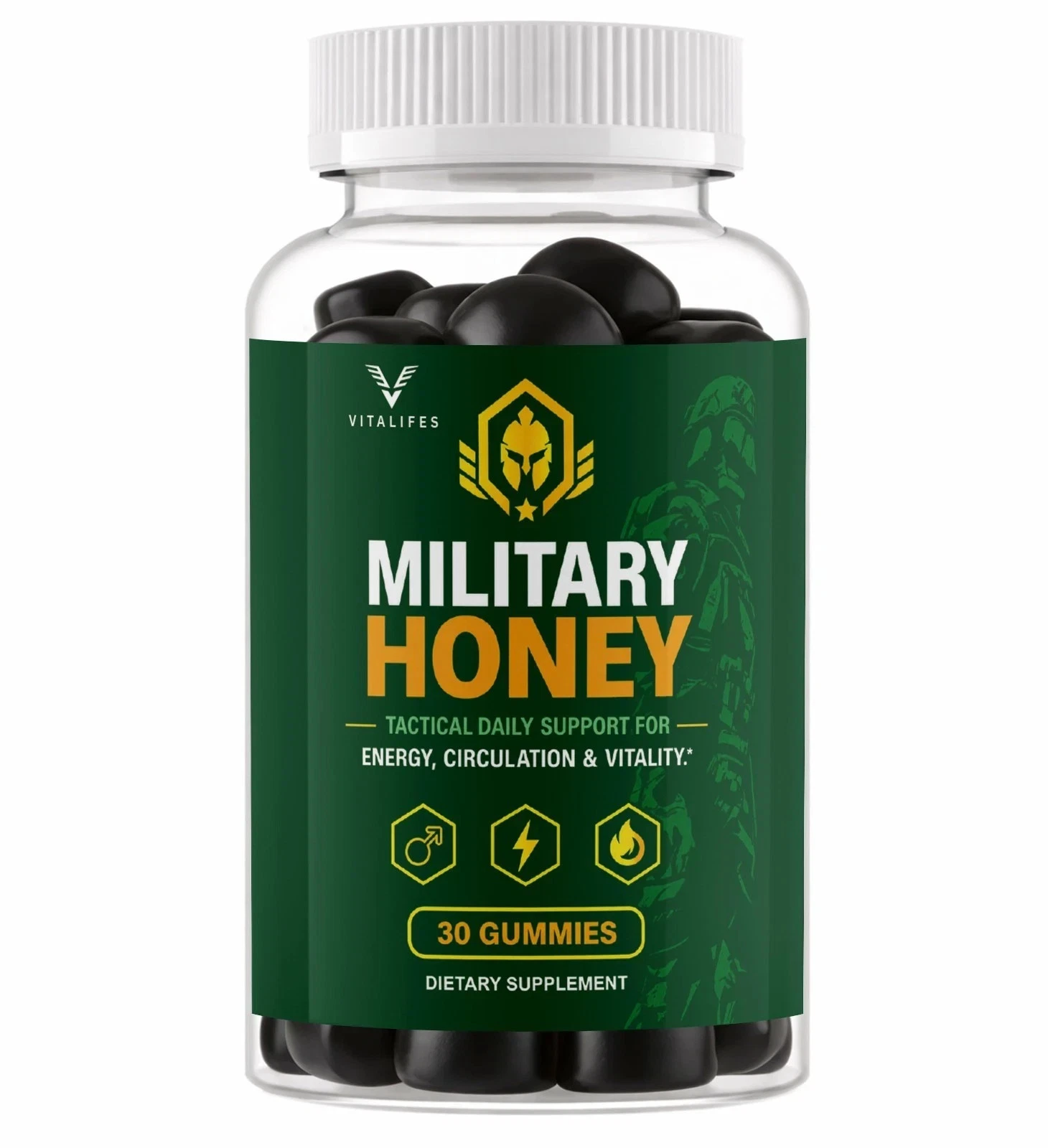
See the full Military Honey label and packs.
Check today’s priceWhy small herb amounts show up on labels
There are a few common reasons. Small amounts cost less. They also fit into a small gummy, which has limited room once you add the gummy base, flavor and sweetener. A gummy that weighs a few grams cannot hold grams of several herbs.
Small amounts can also let a label list many popular names. Buyers recognize names like maca and tribulus, and seeing them on a label feels reassuring. That is why the unit next to each name is so important to read.
None of this is illegal. The label is open in the sense that it states the amounts. It is up to the reader to notice what those amounts mean.
The part that is not small: vitamin D
Here the units work the other way. For a vitamin, 84 mcg is large. The adult Recommended Dietary Allowance is 15 mcg (20 mcg over age 70), and the upper limit, the most adults can take daily without risk, is 100 mcg from all sources combined ((NIH Office of Dietary Supplements, vitamin D fact sheet)).
So one gummy supplies 84% of the upper limit. If you also take a multivitamin or a separate vitamin D, you may go over. Taking two gummies would give 168 mcg. Vitamin D can also be written in international units (IU): 1 mcg equals 40 IU, so 84 mcg is 3,360 IU.
Common unit mix-ups to avoid
- Reading “mcg” as “mg.” This makes an amount look a thousand times bigger than it is.
- Mixing IU and mcg. For vitamin D, divide IU by 40 to get mcg. 4,000 IU is 100 mcg.
- Adding “equivalent” amounts. A “500 mg equivalent” extract may weigh only 50 mg.
- Ignoring the serving size. All amounts are per serving; here, one gummy.
- Forgetting other products. Upper limits apply to your total daily intake, not one product.
The bottom line
A microgram is a thousandth of a milligram. On the Military Honey label, that means the four herbs are 0.1 mg each, roughly 1 mg of raw herb as 10:1 extracts, far below amounts studied in research. Boron, at 7 mg, is a real dose. Vitamin D, at 84 mcg, is a large dose, close to the adult upper limit.
So the gummy’s real story is its vitamin D and boron, not its herbs. Read the units, count every vitamin D product you take, and ask your doctor if you are unsure.
Sources
- NIH Office of Dietary Supplements. Vitamin D: Fact Sheet for Health Professionals. NIH ODS, current revision. Checked September 22, 2026.
- NIH Office of Dietary Supplements. Boron: Fact Sheet for Health Professionals. NIH ODS, current revision. Checked September 22, 2026.
- National Center for Complementary and Integrative Health. Fenugreek: Usefulness and Safety. NCCIH, updated February 2025. Checked September 22, 2026.
- Memorial Sloan Kettering Cancer Center. Maca (About Herbs). MSK integrative medicine database. Checked September 22, 2026.
- Memorial Sloan Kettering Cancer Center. Epimedium / Horny Goat Weed (About Herbs). MSK integrative medicine database. Checked September 22, 2026.
Questions on this topic
More answers on the full FAQ page.
How many micrograms are in a milligram?
1,000. So 100 mcg is 0.1 mg.
How much of each herb is in Military Honey?
100 mcg (0.1 mg) of each 10:1 extract, about 1 mg of raw herb.
Is 84 mcg of vitamin D a lot?
Yes. It is 420% of the Daily Value and 84% of the 100 mcg adult upper limit.
How do I convert vitamin D IU to mcg?
Divide IU by 40. 84 mcg is 3,360 IU.
Ready to try Military Honey?
Pick a pack and see the price at checkout. The money-back guarantee is as printed on the listing. Questions first? The contact page lists every desk.
Sold through a U.S. stocking partner for Military Honey. This site is not the manufacturer and earns when you buy.Keep reading
Vitamin D 84 mcg explained
What 84 mcg (3,360 IU) of vitamin D3 per gummy means: 420% DV, 84% of the 100 mcg adult up…
Read more →Is there honey in Military Honey?
Is there honey in Military Honey? No honey is listed on the Supplement Facts panel. What t…
Read more →Military Honey ingredients
Vitamin D3, boron and four herbal extracts.
Read more →